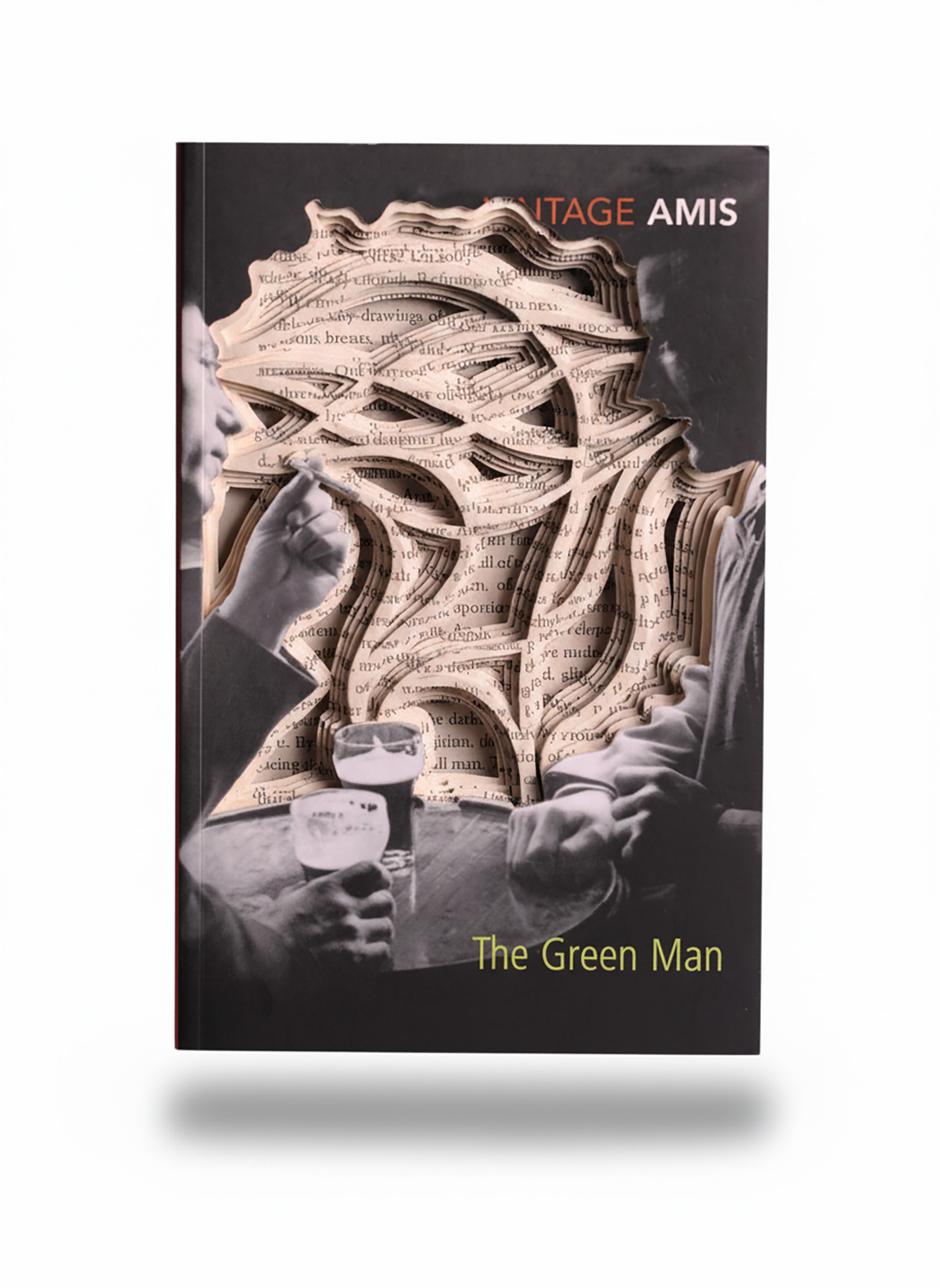
The Green Man belongs to a series in which discarded or damaged books are transformed through hand-carved excavation. By cutting progressively through the material, I expose an internal structure that both reveals and disrupts the book’s original narrative. The carved space becomes an alternative architecture—one shaped not by reading but by looking.
In this piece, the carved interior intersects with the cover image in a way that reorients the viewer’s attention. The emerging lines cut across the figures’ sensory and communicative organs—the eyes, mouths, and hands—and extend toward the objects they interact with. These carved pathways create new conduits between the key elements of the scene, tying them together through a shared internal rhythm. I tried to show the multi-layered waves that flow through even the simplest human communication, allowing the book’s interior topography to reveal connections that remain invisible in the printed image alone.
The final work turns the book into a sculptural terrain, where the interaction between image and carved depth produces a new, layered form of meaning.